Scandal! Corporate tax evasion on an unprecedented scale! Shadowy hedge-funds and offshore accounts; bribery and blackmail and a legion of defrauded investors baying for blood. Behold! A new district attorney in Orange County, where lay the nexus of this web of sin, swearing that this black mark on American capitalism - normally so respectable, so fair, and so morally pure - would not go unavenged.
“Egads, boys,” said the new OC DA to his cringing underlings, in a manner which was not necessarily entirely diegetic, “all this complicated financial stuff is fine and dandy, but that’s not going to hold the attention of the modern American public! I know it’s only 2007 and no-one’s invented TikTok yet, but since the turn of the century attention spans have fallen 46%! If we’re going to maintain public interest, we need… a villain.”
Enter Nigel Rathbone: high-financin’ fat-cat, unabashed bastard and, in his interactions with his fellow man pretty close to a 21st century, pre-ghost Scrooge. The manager of a range of hedge-funds, slush funds, and with more offshore accounts to his name than a thousand David Camerons combined, Rathbone was infamously nasty in financial circles, but wasn’t the sort of person who usually ended up as a household name. His primary vice was avarice, not pride, so he was happy to build up his hoard in secret. Unfortunately for Rathbone his secondary vice was racism, so after one particularly vile outburst he had been sued by an Hispanic employee in the late 90s. This was the only reason that the average joe had heard of him.
For that reason when investigators discovered that he was implicated in the Orange County Hedge Fund Scandal of ‘07 (as it would come to be known), there was a general mood of delight. Of things such as these whole careers were made; and everyone expected Rathbone to have an example made of him. The DA gleefully agreed to prosecute. A crack team of lawyers was assembled to make sure Rathbone wouldn’t have a hope in hell of escaping public wrath. Rathbone himself, allegedly, joked about how long he was likely to last in prison. So quite a few people were miffed when the jurors at Rathbone’s trial returned a unanimous verdict of not-guilty. It had all the makings of a darkly amusing public farce. A major twist took place, however, when Rathbone - having waved to the cameras, and having said something about his (Jewish) lawyer which he, and only he, supposed was terribly funny - died. He had been shot in the back of the head.
It was pretty much at this point that the matter stopped being funny.
A young officer named Sasha had been standing next to Rathbone when he was shot. She was a year out of the academy, and was known to her colleagues as pleasant and competent, but too shy about dispensing violence for their liking. She’d just been trying to keep the media from crowding Rathbone too much, and had turned around to check on his safety at the very moment he’d been killed. Sasha had never seen anyone die before. She had never even seen a dead body before. She was told later that she had frozen for several seconds, but she didn’t remember that. She only remembered someone shoving her over, and almost being trampled by the panicking crowd. She remembered her sergeant’s round, red face as he asked her questions she couldn’t process and she remembered that he called her useless when she stammered over her apology.
By the time she had a clear sense of where she was, Sasha was sitting on the courthouse steps, where some relatively well meaning EMT had draped a blanket over her shoulders. The crowd had been dispersed, there were lines of police tape warding off anyone from approaching. Sasha noticed a few officers through the windows of nearby buildings, hunting for the murderer. She noticed a funny, metallic smell, and realised that some of Rathbone’s blood had spattered into her nostrils. She fainted, but because she was already sitting down it just looked like she was resting her head on her knees, and nobody noticed. She awoke about a minute later, even more disoriented than before. She wanted to cry, or be sick, or something, and wondered what the hell she’d been thinking when she signed up to be a police officer. She heard someone saying her name (“Officer Seyrig”), and she felt her stomach and her bowels constricting inside her, felt a cold wave of cortisol diffusing into her body, because it was - it all was - her fault somehow, if not that Rathbone had been shot, then that his murderer had not already been apprehended, and surely whoever had said her name was explaining this to her superiors. Sasha heard footsteps near her, and she looked up.
It was evening. The sun was low, the sky was a mix of orange and pink; a sweet, rich, soothing melange. The air was cold, but a nice cold; the cold of a clear night unfolding on a summer day, the cold at the end of a long day at the beach. In this light, and in this coolness, and against the richness of this sky, stood a woman. Her name was Cecily, but about seventeen months earlier she had needed an alias. It had been completely off-the-cuff, but had she agonised over the matter for days Cecily would not - she felt - have been able to come up with a better name than ‘Hypatia’.
There was an air of refinement about every aspect of her appearance. She was quite tall, but by no means towering; slender, but by no means waifish; pale, but by no means colourless. Every part of her had been tastefully proportioned, in a fashion that would never be passé. The tapering width of her marble shoulders; the elegance of her swanlike neck; the slim curve of her figure; the silkiness of her long, bronze-red hair. Her features were sophisticated, a little sharp, and a little sweet; with just a touch of an unusual, even elfin quality to her soft smile, and to her wide, bright-blue eyes.
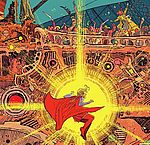
But Sasha could not see Hypatia’s eyes. She wore a black mask over most of the upper half of her face, from the bridge of her nose to her forehead. Over her eyes was a red, one-way gauze that made her expression inscrutable; even fearsome if that was what Hypatia wished. Her trim figure was clad in a leotard, somewhere between the thickness of lycra and of leather, mostly red. From Hypatia’s navel to her neck there was a triangular-ish section, cut across with a red ‘v’ just above her chest, in a glossy black; and emblazoned on that was a single letter in gold: an upsilon, very much like a capital ‘Y’. Hypatia’s tall legs were made to look even taller in a pair of long, heeled, black boots, ending in a slight flaring just above her knees. It left her thighs bare all the way up to her hips, in a tastefully sensuous display of the femininity of her body, the shapeliness of her legs, and the creamy, finespun quality of Hypatia’s skin. Partly inborn; partly accident; partly deliberate; partly earned - such was the beauty of Hypatia’s presence. She was a hero, and Sasha did not feel awed by her presence, as much as she felt comforted.
“Good evening, Officer Seyrig,” Hypatia said. Her voice was a little odd; an accent that was a mix of two very different kinds of high-class American. If one listened very, very carefully, one could detect a distant echo of a childhood speech impediment that Hypatia had trained herself out of: an ever-so-slightly greater sibilance on her ‘s’ sounds; somewhat harder ‘d’ and ‘t’ sounds, too. The way she held herself, the precision she seemed to take with not only her words; but her tone and her cadence, suggested a bright, sharp intelligence. “My name is Hypatia. Your captain was kind enough to allow me to enter the crime scene. May I sit with you?”
“Oh, um… of course.”
Hypatia sat on the step just below the one Sasha was on. She crossed her legs with instinctive elegance, the pressure of one limb against the other showing a subtle hint of definition in her thigh muscles. She rested her hands, clad in long, black gloves, on her lap, tenting her fingers. She didn’t say anything to Sasha. She just waited. A superhero at the scene of a grisly murder, and she seemed to have all the time in the world.
“You want to ask me about the shooting, right?”
“May I? I know it must seem a little odd. With the mask and, uh, the sorority logo on my chest.”
Sasha laughed. It was partly genuine, and partly giggly, shaken nerves.
“It’s alright. I - I just don’t know what to say. I was standing there, trying to hold back the press, I turned around, and then Rathbone had his fucking head blown in.” She covered her mouth. “Sorry,” she mumbled.
“For swearing? No need to apologise.” Hypatia smiled. “Being a ‘cape’ doesn’t mean one expects life to be PG-13 all the time. If ever.”
Sasha laughed again, but this time it was all nerves, and Hypatia waited for her to regather herself.
“Forgive me,” Hypatia said, when she judged enough time to have passed. “I hope this doesn’t come across as pedantic, but I just want to be clear. You turned around - and then this man was shot. You didn’t turn because you heard a gunshot?”
Sasha thought.
“Yeah; definitely.” She made a strange movement with her head; like she was for the first time properly registering Hypatia’s presence. “Wait why do - why are you here? You’re a superhero. What’s this got to do with you?”
“Perhaps nothing,” Hypatia replied. “Certain similarities to another case I was involved in. I wanted to see for myself if there was any connection.”
“Right.” Then, hastily: “Oh, god! I’m sorry - I must have sounded so rude! I was just surprised that you - I mean I’m not one of those cops who - I don’t have a problem with superhumans or anything, it’s just - huh?”
Through her stammering, Sasha had not noticed that the noises around her were dimming: the sounds of sirens, of people shouting, of chattering bystanders. The sounds of the streets beyond; heavy traffic; the sounds of chattering crows in a nearby tree, the sounds of babies crying in apartment buildings. The effect was like a morning after a night of heavy snowfall, when all noise nestled into the snow like sleepy field mice.
“Officer Seyrig.” Hypatia still spoke softly. “I don’t take you for a bigot. On the contrary: people like me are strange. Our relationship with the police is strange. Were I in your position, I might find a cape blundering onto my crime scene to be an impertinence. I am grateful to be permitted to be here at all.”
But, in a state of wonder at the magic Hypatia performed, Sasha had hardly been listening.
“Is it you making it quiet?”
“Mmhmm.”
“How? Do you - can you control sound or something?”
“Oh no, nothing that interesting. I’m telekinetic. All I’m doing is willing the air around us to be still.”
“You make it sound easy.”
“I wouldn’t call it… easy, exactly…” Hypatia’s abilities had come a long way since she had taken that name. There were things she could do now that would have been impossible even two years before. But she could hardly bend reality to her whims: exerting her powers over fluids was still tricky. But the exertion was worth it, for Hypatia had discovered early into her career how much a superhero’s success depended on charisma. Not being a boisterous showman like some of her peers, she had to find quieter solutions to the same problems.
“Now, Officer Seyrig -”
“Please, call me Sasha.”
“Sasha,” Hypatia repeated, with a small, warm smile, “if I have you right, you were facing the victim when he was shot.”
“Mm.”
“And he was shot in the back of the head, wasn’t he?”
“I think so. I mean - he was; that’s definitely what CSI said. I just - I don’t remember too well.”
Hypatia stood up. She looked towards the front steps of the courthouse, where the murder had taken place. It wasn’t a huge building, and the entranceway was quite cramped.
“Then the shooter must have been behind Rathbone. That would put them inside the courthouse itself.”
“I guess so. I didn’t see anyone.”
“But someone ought to have done. The security inside the courthouse, or a bystander - the assassin must have been standing out in the open. But no-one did see the murderer, did they? They got away completely clean.”
Hypatia thought. As her concentration was directed elsewhere, the field of silence she’d conjured dissipated, and the world intruded again. But she was so deeply enmeshed with solving this puzzle that she hardly noticed.
“Sasha,” she said, “how was Rathbone standing when he was shot?”
“I don’t really remember.”
“Try. I know it must be an unpleasant memory, but this is important.”
Sasha did as she was asked. “He wasn’t standing still,” she said. “He was walking forward and then -”
“And then what?”
Sasha snapped her fingers. “He stumbled. He stumbled forward just as I looked back at him. I guess he just tripped on something. When he was shot… when he was shot he was shot in the back of the head, but it wasn’t from behind. He was looking down at his feet. He was -” She stopped abruptly.
“What is it?”
“No, I can’t be right. The way I remember it he must have been shot from above. Like, right above him. But you can see that’s not possible.” She pointed at the front of the courthouse. “There’s a canopy right above where he was killed. There’s nowhere he could have been shot from.”
Yet Hypatia was smiling.
“Sasha,” she said, “you have been extremely helpful.” She took Sasha’s hand, warmly shook it. “May I also say: it’s comforting to meet a police officer who seems to abhor violence as you do. Please excuse me.”
She inclined her head slightly, and moved away, making a mental note to check in on Officer Seyrig, surreptitiously, within the next few days. While Hypatia meant sincerely what she had said, she had noticed a certain fragility in this officer, and wanted to make sure she landed on her feet. People could be funny when they saw real violence for the first time. Hypatia knew that from her own experience.
Hypatia approached the front of the courthouse, the place where Rathbone had been killed. His body had since been moved, and there were still investigators milling about, so Hypatia couldn’t get too close. But she was close enough to look for the signs that she sought. Close enough to see the scratches.
No-one who was not looking for them could possibly have guessed their significance. Eventually, ballistics analysts would come to the same conclusion that Hypatia had; that Rathbone had somehow been shot from above. But they could not guess at how this had been possible, could not have supposed that anyone could pull off the shot that had in fact killed Rathbone, a perfect ricochet off five separate surfaces that ended with the bullet embedded perfectly in the back of Rathbone’s skull; leaving five telltale scratches on the walls and pillars of the courthouse.
A superhuman, then. But of what kind? That ‘previous case’ Hypatia had mentioned had been another apparently inexplicable shooting. The Riverside County police had thought a telekinetic had been involved, which was why Hypatia’s advice had been sought. But the ricocheting didn’t quite make sense for someone with powers like Hypatia’s. It was an unsettling thought, but if Hypatia wanted to kill someone stealthily, she could have done so quite easily, even in plain sight; by messing with their brain stem, or stopping their heart or something. No, this was something else.
“Someone with… heightened senses? Great accuracy? Such powers do exist… but it’s not as if they were assassinating a president. Rathbone was just a financier. They could much more easily have killed him on his way to work. Or in his house.” And what was the motive? One of his alleged victims? A business rival hiring an assassin? “Could be… but again: why do it so publicly? Why draw so much attention?”
Hypatia happened to catch sight of herself, reflected in a window. Not for the first time, it occurred to her that it would have been easy for her to look silly: strutting around a grisly crime scene in a mask; in a leotard and thigh-highs. But she pulled it off. It was all about presenting the right kind of theatricality: that’s how she had been able to keep Sasha calm, and take her into her confidence.
“Theatre…!”
It had been staged. Killing Rathbone right as he came out of the courthouse, with violent and thrilling drama, spilling his blood over the door of the place that had failed to mete out justice. It was a kind of brutal work of symbolism. The assassin was not motivated by money; by a grudge; by revenge - at least not revenge exactly. It was out of an offended sense of justice. They were someone a little more like Hypatia herself.
“A vigilante. A superhuman vigilante…!”
She stepped away from the lights of the police cruisers. She peered out into the darkness, wondering if the organiser of this drama had stayed to watch their production play out. There were still some people at the barriers the police had put up, rubbernecking to see what all the fuss was about, and it even occurred to Hypatia that the assassin was among them. From a distance where she could remain in darkness, she peered at them, but wasn’t close enough to see much; and what she did see wasn’t anything out of the ordinary. Just people who, quite understandably, felt they were standing at the edge of something important. Eventually Hypatia stopped scanning the little crowd, and swept away into the night: for if she was to confirm her hypothesis, she had much to do.
She did not see that one in the crowd had observed her watching them. She did not see that they made a point of waiting a good minute or so after Hypatia had left before slinking away themselves.
“Hypatia,” this person thought. “Will she be a problem, I wonder?”
____________________________________________________________________________